Masonry is a dry-season trade. Cement wants water on its own terms, not from the sky, and almost every leak that appears in July was visible in March to anyone who looked. This is what to do in each season, and what to do when the walls get wet anyway.
Before the monsoon: the one afternoon that matters
Pick a Sunday in March or April and go round the building with a torch, a coin and a bucket.
The terrace. Clear every drain of leaves, plastic and the pigeon nest. Pour a bucket at the far corner and watch where it goes; it should reach a drain without stopping. Look at the parapet junction all the way round for a dark line or a gap. Look at the base of the water tank and the AC outdoor units, where pipes are often resting in a puddle. Any crack you can see in the screed is a crack water will use.
The exterior walls. Stand across the road and look for dark vertical streaks under windows and at pipe outlets; those are the places rain runs and gets in. Cracks at the corners of windows are the usual entry points. A hollow patch of exterior plaster found by tapping now is ₹1,200 to fix; found in August as a sheet of plaster on the ground, it is ₹28 per sq ft of new plaster and a wait until October.
The bathrooms. Pour a bucket on each bathroom floor. It should run to the drain in seconds. Water that sits in a corner is water that will go through the floor. Check the grout lines in the shower area with a fingernail; soft or missing grout is a ₹18 per sq ft epoxy job that takes an afternoon.
The ground floor walls. Look for a tide mark a metre up and white salts along it. Rising damp gets worse in the monsoon as the ground saturates; the treatment is a dry-season job.
The balcony. The underside of your balcony and the one above. Rust stains, hairline cracks, or concrete bulging over the steel mean spalling, and the ₹6,000 patch is far cheaper done before a monsoon than after a piece falls.
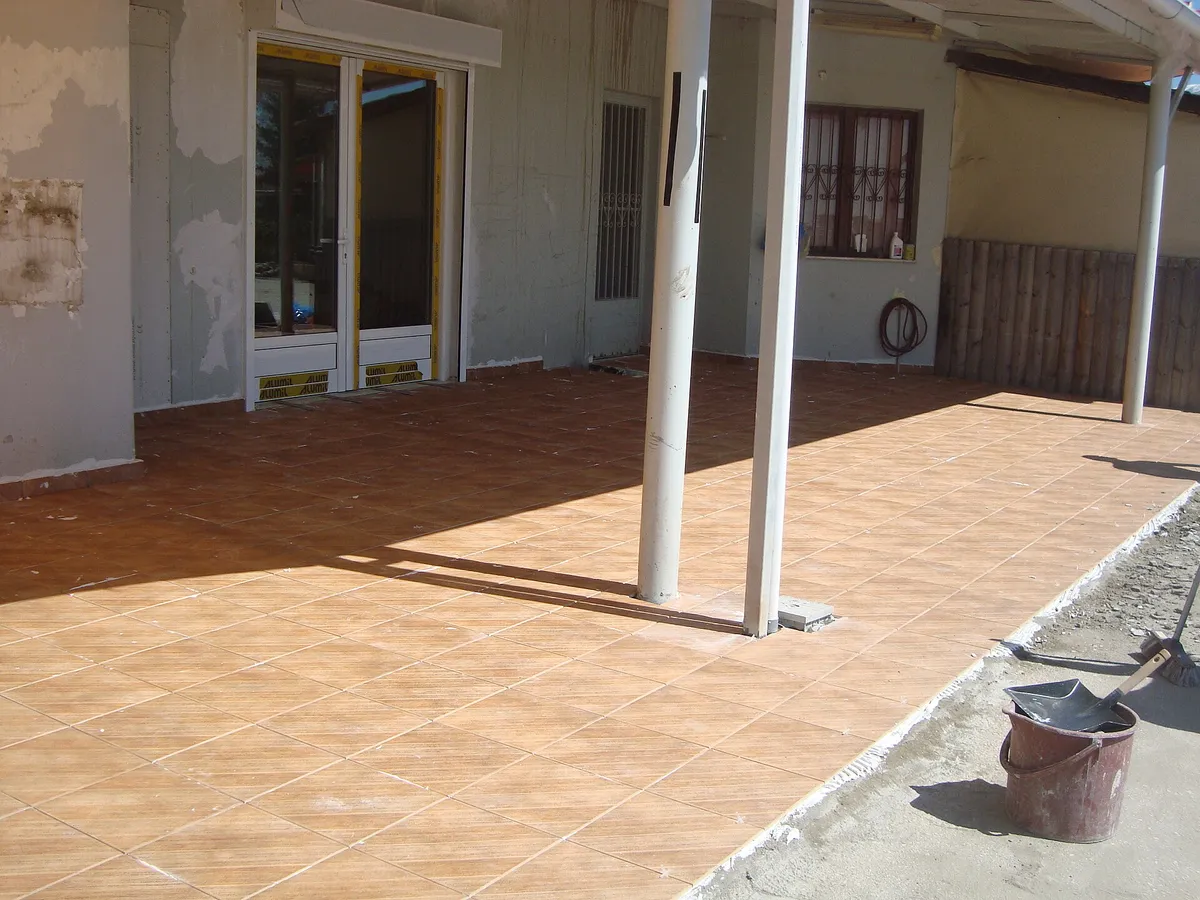
Everything on this list that needs a mason is a dry-season job. Terrace waterproofing at ₹60 per sq ft needs a week of dry slab before and dry days after. Exterior crack sealing and plaster need dry walls. Book them in March and they are done before the first rain; book them in June and the mason, rightly, says October.
During the monsoon: what masons will and will not do
Interior work carries on: tiling, interior plaster, a partition wall at ₹65 per sq ft, a bathroom re-tile at ₹15,000. Humidity actually helps curing indoors.
Exterior plaster, terrace waterproofing, parapet repairs and anything on a ladder outside stop. Fresh plaster that gets rained on loses its cement to the surface and sets weak. A membrane applied to a damp slab peels. A mason who agrees to do your terrace in July is either going to do it badly or going to wait for a dry week and hope.
If the walls get wet in the rains:
- Find the source now, while it is active. Photograph the stain at its biggest and date it. Trace up: terrace, balcony, bathroom, pipe outlet. A leak is easy to find when it is running and hard to find in November.
- Do not treat the wall yet. Seepage treatment at ₹45 per sq ft on a wet wall fails. Let it dry after the rains, then treat.
- Move furniture and electricals away from the wet patch and keep a fan on it; mould grows on a wall that stays wet for a fortnight, and the painter's guides cover what to do about it.
- In a flat, write to the society and to the neighbour above the same week, with the photograph. The repair is usually theirs or the society's, and the paper trail starts the day you notice.
Summer: the curing problem
Masonry in May has the opposite problem: the water leaves too fast. Plaster laid at 40 degrees in a dry wind can lose its water in an hour, before the cement has reacted, and it crazes. A tile bed that dries before the tile is pressed in leaves hollow tiles.
The mason's answer is shade, timing and water. Plaster is laid early or late, not in the midday sun on a west wall. The wall is wetted before and sprinkled three times a day instead of twice. A new floor is ponded with a mud dam and kept under water for a week. If you are paying ₹28 per sq ft for plaster in summer and the mason is not coming back to sprinkle it, it is not finished.
After the monsoon: the repair season
October to February is when terrace waterproofing, exterior plaster and crack sealing get done, which means masons are busiest then. The stains you photographed in August tell you where. The order that works:
- Terrace and parapets first, at ₹60 per sq ft, once the slab has had a dry fortnight.
- Exterior cracks and hollow plaster, ₹1,200 per patch.
- Interior seepage treatment, ₹45 per sq ft, only after the source above is sealed and the wall has dried.
- Then the painter, after seven days of curing on any new plaster.
The annual visit
Once a year, in February, a mason's visit at ₹300 to walk the building with you. Tap the tiles in the wet areas, tap the exterior plaster within reach, check the terrace drains and slope, look at the underside of balconies, and look at every crack you marked last year to see whether it has grown. Most of what they find is a half-day at ₹1,000 with a helper at ₹600. Houses that have this done do not call in August.
The festival-season jobs
The weeks before Diwali are when people want a bathroom re-tiled or a kitchen platform rebuilt, and the weeks when masons are already booked. A bathroom is seven working days including the water test and curing; a kitchen platform at ₹4,500 is two or three with curing before the granite goes on. Book in September for October, or accept that the curing days cannot be skipped to meet the date.
Related guides
The painter's seasonal guide covers what the monsoon does to paint and why exterior painting waits for the same dry window. The architect's guides cover terrace gardens and the load they put on a slab that was never designed for them.