Electrical faults in India follow the calendar. The monsoon finds every wet point, summer finds every undersized AC line, and Diwali finds every overloaded socket. A short checklist in each season, and one annual visit, prevents most of the calls the rest of this library describes.
Before the monsoon: the one afternoon that matters
Do this in May, before the first rain, not after the first trip.
Outdoor and balcony points. Every socket, light and switch that is exposed to rain needs a weatherproof cover, a ₹150 part. Check that the cover closes, that the gasket is not perished, and that the back box is not full of last year's water. An electrician replaces a weathered outdoor point for ₹900, and fits a balcony or gate light properly for ₹450.
The pump and its starter. The borewell or sump pump's starter box is often the wettest electrical item on the property. Open it, dry it, check the cable gland where the wire enters, and make sure the float switch in the tank moves freely. A starter replacement is ₹800, a float switch ₹700.
Walls that leak. A wall that shows damp patches in the rains has conduit inside it that fills with water. Look at the switchboards on that wall: any rust at the screws, any discolouration, and that board needs moving or sealing before the water reaches the terminals. Finding and fixing a fault after rain is ₹1,200; preventing it is a tube of sealant.
The earth pit. Earthing depends on moist ground around the plate, which is why it is tested before the monsoon, when the ground is driest and the reading is worst. If the reading is above five ohms, the pit needs salt and charcoal topping up, or a new pit at ₹5,000. A good earth is what makes the RCCB useful when everything is wet.
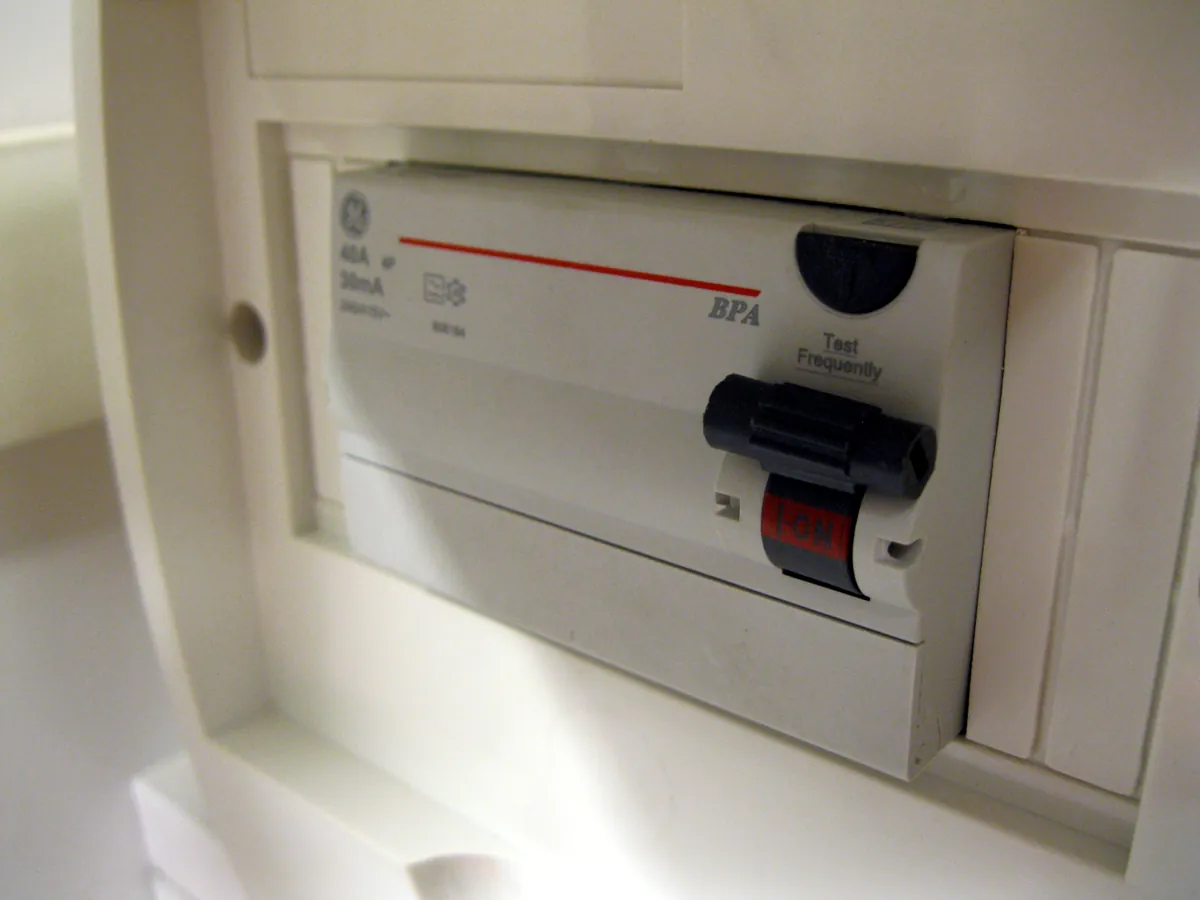
The RCCB. Press the test button. It should trip. If there is no RCCB, the monsoon is the reason to fit one at ₹1,200: a wet house without one is where shocks happen.
When the board trips after rain
It will happen anyway, in the first week of heavy rain, in most houses. The order to do things in:
- Reset the RCCB once. If it holds, note the time; a point that was wet has dried.
- If it trips again, switch off the MCBs for the outdoor, balcony and pump circuits, then reset. If it now holds, the fault is outside and the house can run on the remaining circuits until the rain eases.
- If it still trips with the outdoor circuits off, switch off every MCB, reset the RCCB, and bring the MCBs back one at a time. The one that trips it is the wet circuit.
- Leave that circuit off and call. ₹1,200 covers finding the wet point, drying it and sealing or moving it.
Do not bridge the RCCB, and do not accept an offer to. It is tripping because current is leaking through water, and the next thing it leaks through may be a person.
Summer: the AC load
Every April the same call: the AC trips its MCB at three in the afternoon. The compressor draws more on a hot day, the MCB that was fine in March is at its limit in May, and a shared circuit with the microwave or a second AC tips it over.
- One AC, one line. Each AC on its own 4 sq mm run with its own 20A to 32A MCB. A dedicated line is ₹1,400; upgrading the MCB and wiring on an existing line is ₹900.
- The stabiliser. Check the AC's label first; many inverter models accept 130 to 290 V and need no stabiliser. If one is needed, ₹400 fits it. A stabiliser with a working time-delay protects the compressor after the evening power cuts.
- The main. A 2 BHK running two ACs, a geyser and a kitchen can draw more than an old 32A main allows. The ₹3,500 meter-to-board upgrade is the fix; a bigger main MCB on a thin cable is not.
- Coolers. A desert cooler on a balcony is a wet appliance on an outdoor point; it needs its own earthed point at ₹500 and a cover when it is off.
The service of the AC itself, gas, filters and the coil, is the AC technician's job in March. The electrical side above is the electrician's in April, before the heat.
Festival season: the lights
Diwali lighting is a few hundred watts per string, which is nothing, and ten strings on one 6A socket through a chain of multi-plugs, which is a fire. The rule is one string per socket, nothing on an extension board that is itself on an extension board, and LED strings only; the old filament strings pull ten times the current and get hot.
If the house hangs lights every year, a dedicated outdoor point with a weatherproof cover near where they hang is ₹900 and ends the extension cords for good. A sensor light at the gate for the dark evenings is ₹500.
The annual visit
One maintenance visit a year, before the monsoon, is the single thing that prevents most of the faults in this library. On TheHire it is ₹800 and it covers:
- Every connection on the board tightened. Connections loosen with years of heating and cooling; a loose neutral is the cause behind flicker, dimming and the odd dead socket.
- The earth tested and the reading written down.
- The RCCB tested, and fitted if there is none.
- The heavy points, geyser, AC, kitchen, checked for heat marks and correct ratings.
- Outdoor points checked and covered.
- The board labelled.
A house that has had this done does not call in the rains. Combine it with the ₹900 safety audit and written report in the first year, which gives you the full list of what the house needs, and the annual visit thereafter keeps it that way.
The winter items
Winter is quieter, with two exceptions. Room heaters are two kilowatts each and belong on a 16A point, never on an extension board; the cord of an extension board under a heater is the commonest winter fire. And geysers run harder and longer: a geyser that trips in December has an element on its way out, and a ₹500 repair in November beats a cold shower in January.