Six decisions come up around air conditioning in an Indian home, and the honest answer to each depends on how many hours the room is used, how old the machine is, and how reliable the supply is. Here are the trade-offs, so the choice is yours rather than the showroom's.
Inverter or fixed speed
Fixed speed runs the compressor at one speed: on until the room is cold, off until it warms, on again. Each start is a surge. The unit is cheaper to buy, simpler, and its PCB costs a fraction of an inverter board, so repairs are cheaper too.
Inverter varies the compressor's speed to match what the room needs. It holds temperature within a fraction of a degree, is much quieter, starts gently, and uses noticeably less electricity over a long night. The costs are a higher price, a more complex and dearer board, and a smaller pool of technicians who can diagnose it properly.
When each is right: inverter for a bedroom or living room used daily through the season, which is most rooms in most Indian homes; fixed speed for a guest room, a shop counter, a room used a few hours a week, or where you want the cheapest possible repair later. An inverter unit also forgives slight oversizing, because it slows down instead of short-cycling.
Split or window
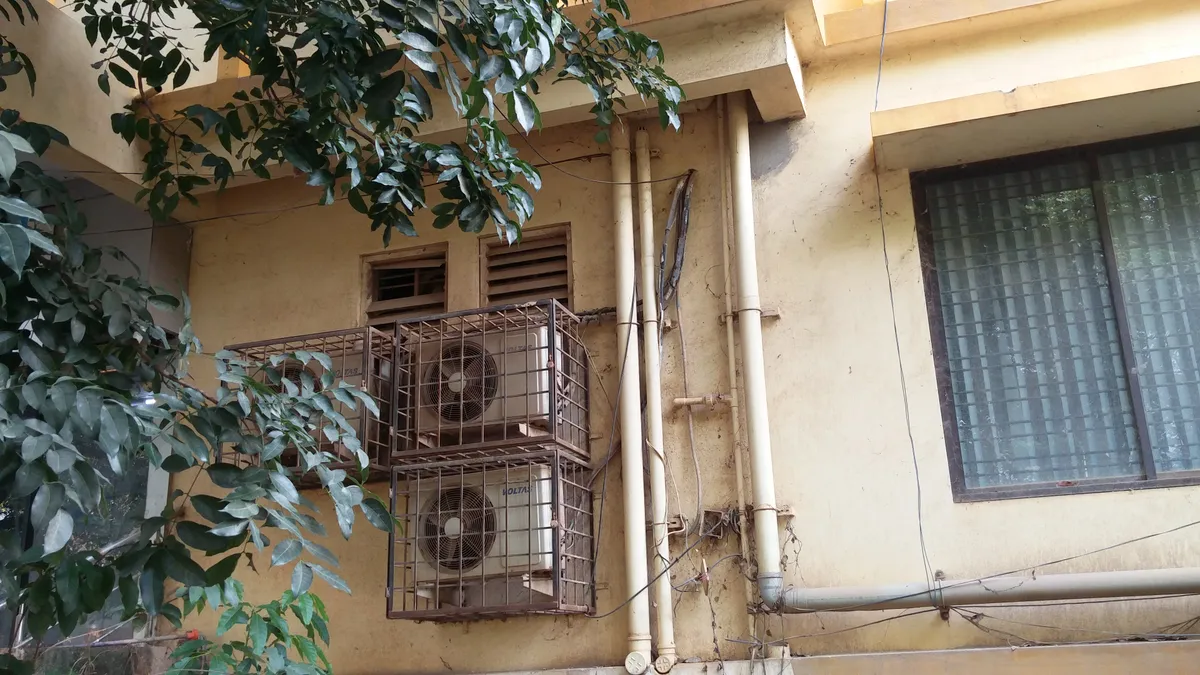
Split puts the compressor outside, so the room is quiet, and the indoor unit is small and high on the wall. It needs a place for the outdoor unit with air in front of it, copper pipe between the two, and a proper installation with a vacuum. Installation is ₹1,500 with up to about 3 metres of copper, and ₹450 per metre beyond that.
Window is one box in a window or a wall sleeve. Noisier in the room, less efficient, fewer models now, and it needs a window of the right size. But there is no copper pipe to leak between two units, nothing to fall off a wall, and installation is ₹600. Service is ₹450.
When each is right: split for almost every owned home; window for a rented room, a small room with the right window, a very tight budget, or a place where an outdoor unit cannot be hung safely. If you move often, a window unit goes with you for the price of two installations; a split costs ₹700 to remove and ₹1,500 to refit, or ₹2,200 as a shift.
Repair or replace
The question that costs the most to get wrong. Work through it in this order.
What is the fault? A capacitor at ₹500, a fan motor at ₹1,200, a sensor at ₹600, a drain at ₹500: repair, at any age. These are small parts on a machine whose expensive bits are fine.
A PCB? ₹1,800 to repair, or the brand's price to replace. Repair is worth trying on any unit; a dear inverter board on an eight-year-old machine is where it gets marginal.
A compressor? ₹2,500 in labour plus ₹6,000 to ₹15,000 for the part. Check the warranty card first; many compressors carry a long manufacturer's warranty and the part may be free. If it is not, and the unit is past eight years, price a new AC before saying yes.
What gas is it on? An R22 unit is on a gas that is being phased out and gets dearer every year. A significant repair on an R22 machine is money into a dead end.
The rule of thumb: if the repair costs more than about a third of a new unit of the same size, and the AC is past eight years, replace. Add to the replacement side that a new 5-star inverter uses markedly less power than a ten-year-old 2-star unit, so some of the new unit pays for itself on the bill.
AMC or pay per call
Pay per call. Two wet services a year at ₹500 each, plus whatever breaks. You choose the technician each time and pay only for work done. In May you wait with everyone else.
AMC. ₹2,500 per AC per year for two services and priority when the city is booked; ₹3,500 a year for the fridge and washing machine together. Read what it excludes: gas and compressors are usually extra, and a contract that covers "all parts" on an old machine is priced for that.
When each is right: pay per call for one or two units, where the arithmetic is a wash and flexibility is worth more. AMC for three or more units, for a house where nobody will remember to book the February service, or for a top-floor flat where a failure in May is unlivable rather than annoying. Either way, the February service is the one that matters.
Stabiliser or no stabiliser
No stabiliser is right when the AC's nameplate lists a wide operating voltage range, as most inverter units now do, and your supply stays inside it. The manufacturer says so on the label; a dealer who insists otherwise is selling a stabiliser.
A stabiliser is right when the supply sags or spikes outside that range, which is still common in smaller cities and on overloaded evening feeders, and for older fixed-speed units with a narrow range. It is also cheap insurance against a PCB repair at ₹1,800 plus a board.
How to decide: read the range on the nameplate, then ask the electrician what the voltage actually does in your area in the evening. It is a ten-minute measurement and it settles the question. Fitting is the electrician's small job, not the AC technician's.
How to handle the summer load
The last choice is about the house, not the machine: three ACs running on a hot evening is a serious load, and there are three ways to carry it.
Strengthen the wiring. A dedicated 20A line and MCB per AC, 4 sq mm wire, proper earthing. This is not optional; it is the electrician's job and it comes before anything else.
Reduce the load. Inverter units, 24 degrees, dry mode in humidity, curtains on west windows, and running one AC in a shared room rather than two in separate ones. The cheapest kilowatt is the one not used.
Generate it. Rooftop solar sized against the ACs' running current, which is why that number belongs on every service bill. Solar covers daytime cooling well and evening cooling only with batteries, so it suits a house that is occupied in the day.
The pattern behind all six
In each case the costlier option buys either less electricity later or less inconvenience in May. The cheaper option is easier to repair and easier to walk away from. Rooms used daily justify the first; rooms used occasionally do not, and an old machine on a dying gas justifies neither.
Whichever way you go, the labour is on the rate card by the unit and by the job, and the cost estimator will put your list of units into one quote you can hand to the technicians who reply.