Hiring an AC technician is mostly about one question: do they find the fault or sell the gas. Gas is the easiest thing to charge for and the hardest for a customer to check, and a technician who tops up without finding the leak is booked again next April. Here is how to tell the two apart before anyone opens the outdoor unit.
On the phone: five questions that sort the professionals
- "What is the visit charge, and is it adjusted if I go ahead?" The answer should be a number near ₹300, or ₹400 for a not-cooling diagnosis, and a yes.
- "Do you carry a vacuum pump and a gauge set?" The right answer is yes without a pause. A technician without a vacuum pump cannot charge gas properly or install an AC properly, and should not be doing either.
- "If it needs gas, how do you find the leak?" Listen for: soap solution on the flare joints, a pressure hold test, nitrogen if it is slow. "We just top it up" is the wrong answer.
- "Which gases do you carry?" R32 and R410A by name, and R22 for older units. A technician who carries one cylinder for everything is not the one you want on an inverter unit.
- "Do you work on inverter units and this brand?" Inverter boards and their error codes are brand-specific. An honest "not that brand" is worth more than a confident guess.
For an installation, add: "Is the copper pipe included, and up to how many metres?" and "Do you pull a vacuum before opening the valves?" For a fridge or a washing machine: "Do you repair the PCB or replace it?"
At the door: what to look for
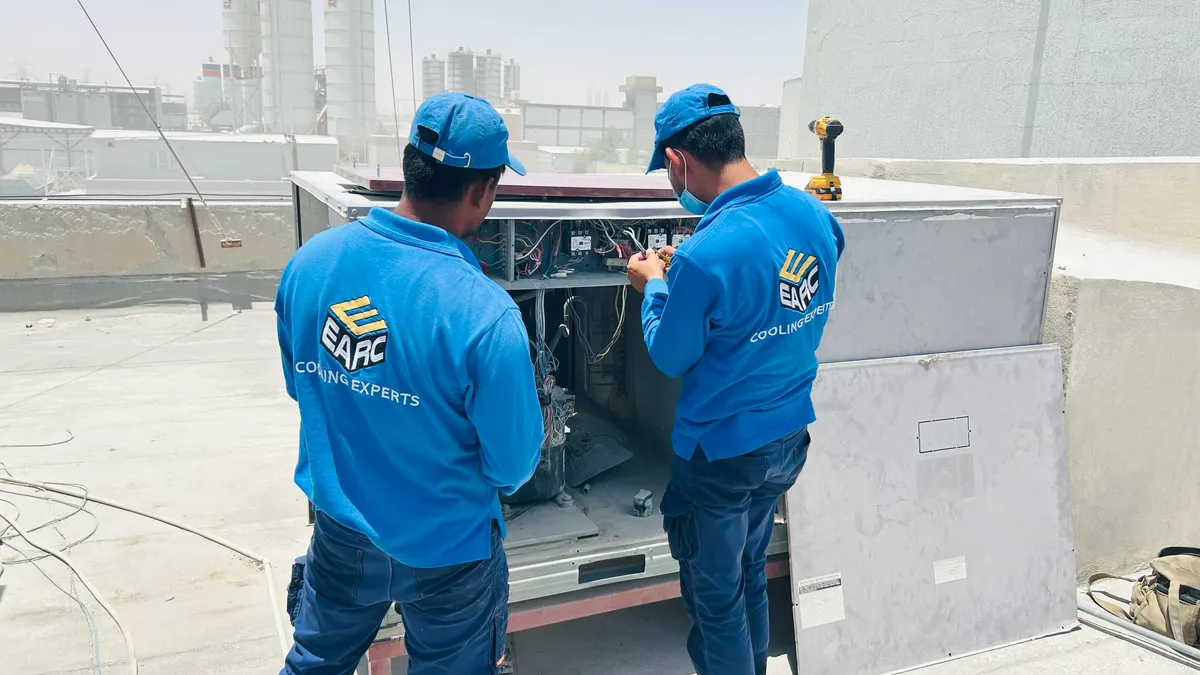
A professional technician arrives with a gauge manifold, a clamp meter, a vacuum pump, a flaring tool, a jet-wash pump for the coils, a cover sheet for the wall below the indoor unit, and a box of capacitors. They look at the filters and the coils before they say anything about gas. They put the clamp meter on the compressor and the gauge on the service port and tell you both numbers. They ask which MCB the AC is on.
They clean up: a technician who leaves the indoor unit's wash water running down the wall is a technician who leaves the flare nut loose.
Red flags
- Gas first. "It needs gas" before the filters have been looked at or a gauge has been connected.
- No vacuum pump. Gas charged into lines that were open to air is a compressor with a short life.
- A top-up every summer. The leak was never found. Ask where it was and to see the joint.
- Venting gas to the air when uninstalling a unit, instead of pumping it down into the outdoor unit. It is wasteful and it is the sign of a technician in a hurry.
- A compressor on a hunch. The compressor is condemned by its current draw and a winding test, not by a hum. Ask for the reading.
- "Replace the PCB" with no attempt at a repair and no error code named.
- A lump-sum quote for three units and a gas job. Nobody can check a lump sum.
- No old parts. The capacitor, the board, the motor they replaced should be handed to you.
What a fair quote looks like
A quote has four parts, each on its own line.
Visit or diagnosis. ₹300, or ₹400 for a not-cooling diagnosis, adjusted against the work.
Labour, per unit. A wet service at ₹500 per split or ₹450 per window unit; a jet service at ₹800; gas with a leak repair at ₹2,500; an installation at ₹1,500; an uninstallation at ₹700; a shift at ₹2,200; a capacitor at ₹500 with the part; a PCB repair at ₹1,800; a compressor at ₹2,500 in labour; a fridge gas charge at ₹1,800; a washing machine bearing at ₹1,800.
Parts, with the bill. Copper pipe at ₹300–₹600 per metre, a stand at ₹400–₹1,200, a compressor at ₹6,000 to ₹15,000, a PCB at the brand's price, a fan motor at the brand's price. The part's warranty card should come to you.
Adjustments. Metro cities about 30 percent higher. Same-day in May about 20 percent more. Flexible timing a little less. More than four units or jobs, a discount from the fourth. Fair if on the quote; not fair if discovered on the bill.
The TheHire cost estimator produces exactly this structure for your list of units and jobs in your city, and you can share it with the technicians who reply so everyone starts from the same numbers.
What to agree before work starts
- Which units and which jobs. "Service both bedrooms, diagnose the hall" is three lines, not one.
- The gas rule. If gas is needed, the leak is found and shown before any is charged, and the pressure is written on the bill.
- Parts. Whether the technician brings them or you buy from the brand, and that the old part is left with you.
- Access. Who provides the ladder or the second person for an outdoor unit on a ledge, and what that costs.
- The electrical point for an installation: ready, dedicated, 20A, done by the electrician before the installer comes.
- The return policy. A fault that comes back within a few weeks is revisited without a second visit charge.
- For a compressor or an old unit, a plain answer to "is this worth repairing?" before the money is spent.
After the work
Run every unit with the technician still there, for long enough that the thick pipe is cold and sweating and the outdoor fan is pushing warm air. Ask for the two numbers, pressure and running current, on the bill. For a gas job, look at the repaired joint. For an installation, see the vacuum pump run and the drain drip. Keep the bill and any warranty card. And write a review: the next household with a unit that trips at 3 pm is choosing on it.
When you need more than a technician
Three jobs sit on the border with other trades, and a good technician will say so.
The point and the wire. A 20A socket on its own MCB with 4 sq mm wire and earthing is the electrician's. An AC that trips a shared breaker is not an AC fault.
The stabiliser and the supply. Whether the house needs a stabiliser is on the AC's nameplate; fitting one, or finding a loose neutral that is dropping the voltage, is the electrician's.
Solar. If the plan is to run the ACs on rooftop solar, the sizing and the inverter are the solar installer's, and the technician's contribution is the running current of each unit, which should be on the bill.