An AC does not make cold. It moves heat from the room to the outside, and every part of the machine exists to do that one thing. Once you know the loop, most of what a technician says makes sense, and most of the sales talk does not.
The loop
Inside the pipes is a refrigerant, a gas that boils at a very low temperature. It goes round a closed loop through four parts.
- The compressor, in the outdoor unit, squeezes the gas. Compressing it makes it hot and high-pressure.
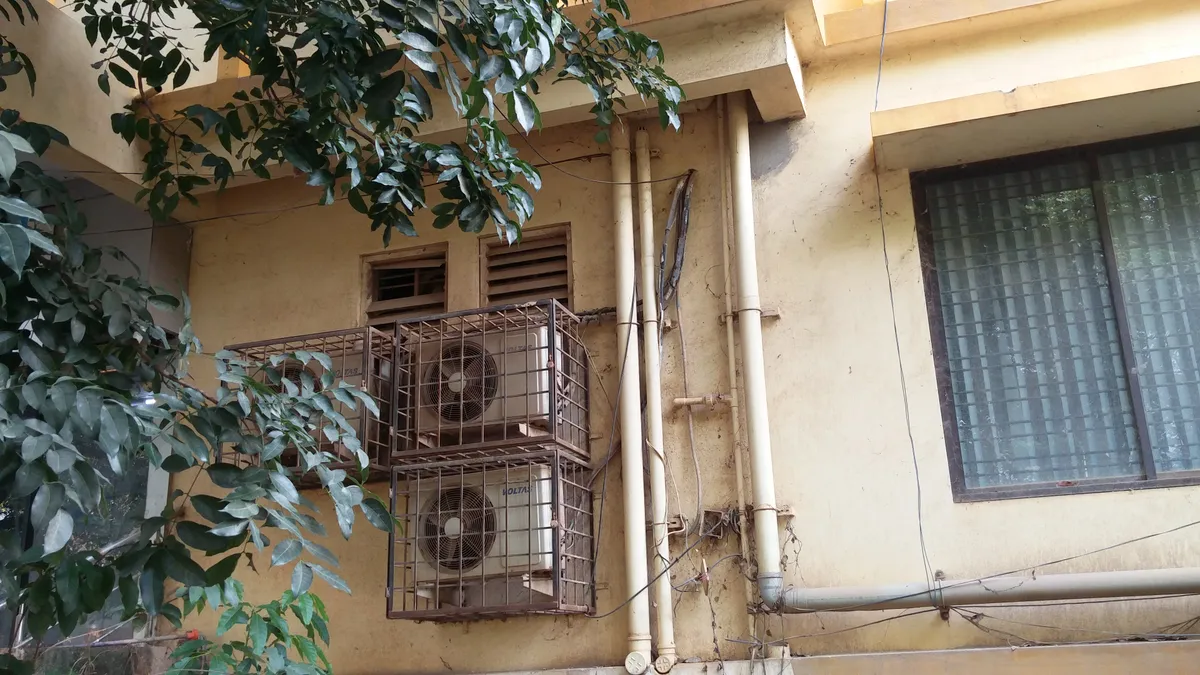
- The condenser, the coil with fins in the outdoor unit, is where the outdoor fan blows air across the hot gas. The gas gives up its heat to the outside air and condenses to a warm liquid. This is the heat from your room leaving the building.
- The expansion device, a capillary tube or a valve, lets the liquid through a tiny opening into low pressure. The drop in pressure makes it very cold.
- The evaporator, the coil inside the indoor unit, is where the indoor blower pushes room air across the cold liquid. The liquid absorbs the room's heat, boils back to a gas, and the cooled air comes out of the louvres. The gas goes back to the compressor and round again.
The two copper pipes between the units are the loop: the thin one carries liquid out, the thick, insulated one carries cold gas back. That is why the thick pipe is cold to touch and why ice on it means something is wrong.
Why gas does not run out
The loop is sealed. The same charge of gas goes round for the life of the machine. If the pressure is low, gas has leaked: at a flare joint on either unit, through a pinhole in a corroded coil, or at a valve. A top-up without a leak repair is a top-up you buy again. The ₹2,500 rate includes the leak check; the ₹1,500 top-up is for a small leak that has been found and fixed.
Two things are true of modern gases. R32 and R410A run at higher pressures than the old R22, so a leak empties the system faster. And they must be charged into a vacuum: a technician who releases new gas into lines full of air and moisture leaves the compressor to pump both for the rest of its life, which is short.
Why dirty filters cost more than gas
The evaporator can only absorb heat from air that reaches it. A filter clogged with dust lets through a fraction of the air, so the coil gets colder than designed, the moisture on it freezes, the ice blocks more air, and the AC runs all night cooling nothing. Then the ice melts and the drip tray overflows into the room.
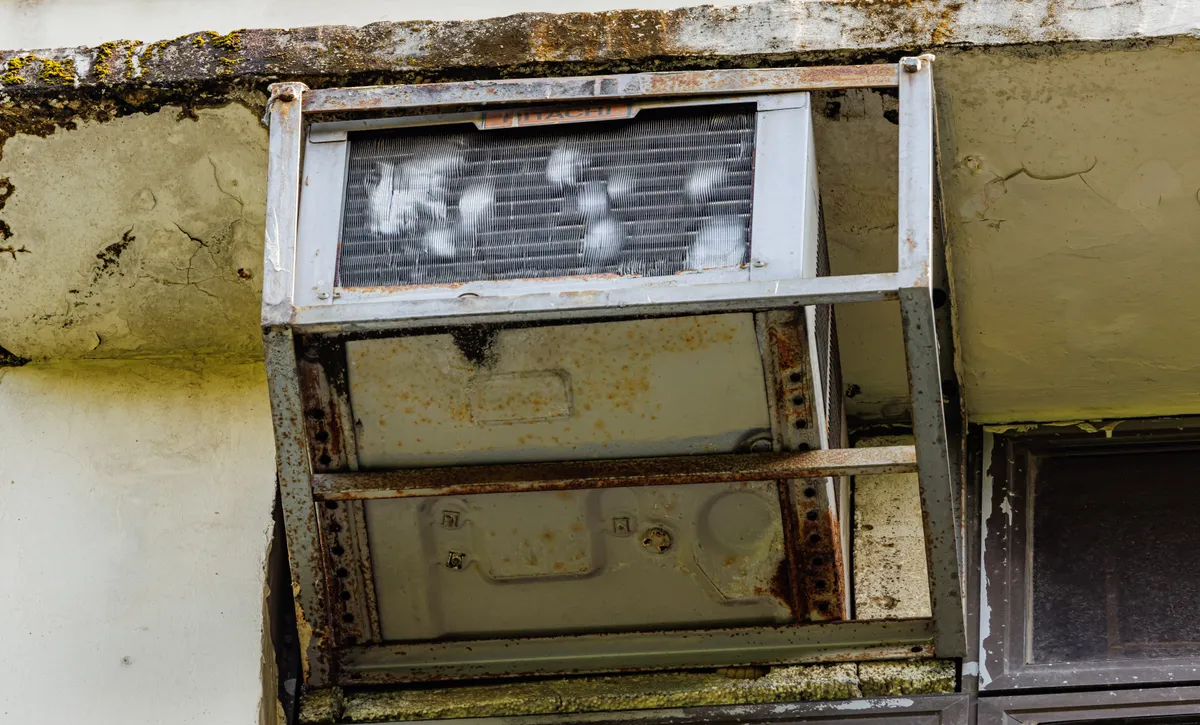
On the outdoor side, a condenser coil clogged with dust and cottonwood cannot give up its heat. The gas comes back to the compressor still warm, the compressor works harder, draws more current, and on the hottest afternoon its overload protection trips. It cools again at night because the outside air is cooler. The customer calls it "low gas". It is a dirty coil, and a ₹500 wet service fixes it.
The electrical parts
The capacitor stores a charge to give the compressor and the fan motors a kick at start-up. In Indian heat it is the part that fails most, and when it goes the compressor hums and trips, or the outdoor fan does not spin. It is ₹500 with the part, and a technician who names it from the hum is usually right.
The PCB is the control board in the indoor unit, and on an inverter AC a second power board in the outdoor unit. It reads the thermostat, runs the fans, times the compressor and shows error codes. Voltage spikes and lightning are what kill it. Repair is ₹1,800; an inverter board is dearer to replace than a fixed-speed one.
The fan motors, one indoor and one outdoor, move the air across both coils. A grinding or a hum with a still fan is a motor at ₹1,200 plus the part.
The thermistor is the sensor that reads the room and the coil. A failed one makes the AC cool in bursts or not at all; the sensor or a remote receiver is ₹600.
The compressor is the heart, and the one part that justifies a long warranty. It fails from running hot for years, from a bad capacitor left too long, from moisture in the gas, or from voltage. Replacement is ₹2,500 in labour plus the part.
Inverter and fixed speed
A fixed-speed compressor is on or off. The room cools past the set point, the compressor stops, the room warms, it starts again, with a jolt each time. An inverter compressor runs continuously at the speed the room needs, so the temperature holds within a fraction of a degree, the start-up surge is gone, and the night's electricity is lower. The cost is a more complex outdoor board. The cycle inside is the same.
The drain
The cold evaporator condenses the room's humidity, several litres a night in a coastal city. A tray under the coil catches it and a pipe takes it outside. The pipe needs a continuous downward slope, a clear end, and no sag where slime can collect. A unit that drips into the room has a blocked drain, a tray that has shifted, or an indoor unit mounted without a slope. The fix is ₹500; a longer drain is ₹300.
What the numbers on the sticker mean
Tonnage is cooling capacity: one ton is roughly 3.5 kW of heat removed per hour. ISEER is the cooling delivered per unit of electricity, weighted across an Indian year; the BEE stars are bands of it. Rated current is what the unit draws when running, and the technician's clamp meter reading against it tells a lot: high means a dirty coil or a struggling compressor, low means low gas. Operating voltage range is on the nameplate and decides whether you need a stabiliser.
Five things every householder should know
- Filters every two weeks in season. Slide them out, rinse, dry, slide back. It is the single biggest thing between you and the ₹400 call.
- Ice on the thick pipe means stop. Switch the AC off, let it thaw, clean the filters. If it ices again, it is low gas or a fan, and that is the technician's.
- The outdoor unit needs air. Not boxed in, not facing a wall a foot away, not buried under a cover in summer.
- 24 degrees is the number. Every degree lower costs more power and the room does not cool any faster; the compressor runs at the same speed either way.
- Gas that needs topping up every year is a leak. Ask where it is.
What is fine to do yourself, and what is not
Fine: cleaning the filters, wiping the louvres, clearing the end of the drain pipe, brushing leaves off the outdoor grille with the power off, replacing the remote's batteries, switching to dry mode in the monsoon, and resetting the MCB once if it trips.
Not: opening either unit, anything with the gas, the capacitor (it holds a charge after the power is off), the PCB, the fan motors, and moving the outdoor unit. Those are the technician's at the rates above, and a ₹300 visit is cheap against a compressor.